After Vincent van Gogh
The Walls Were Violet
“The walls are of a pale violet.”
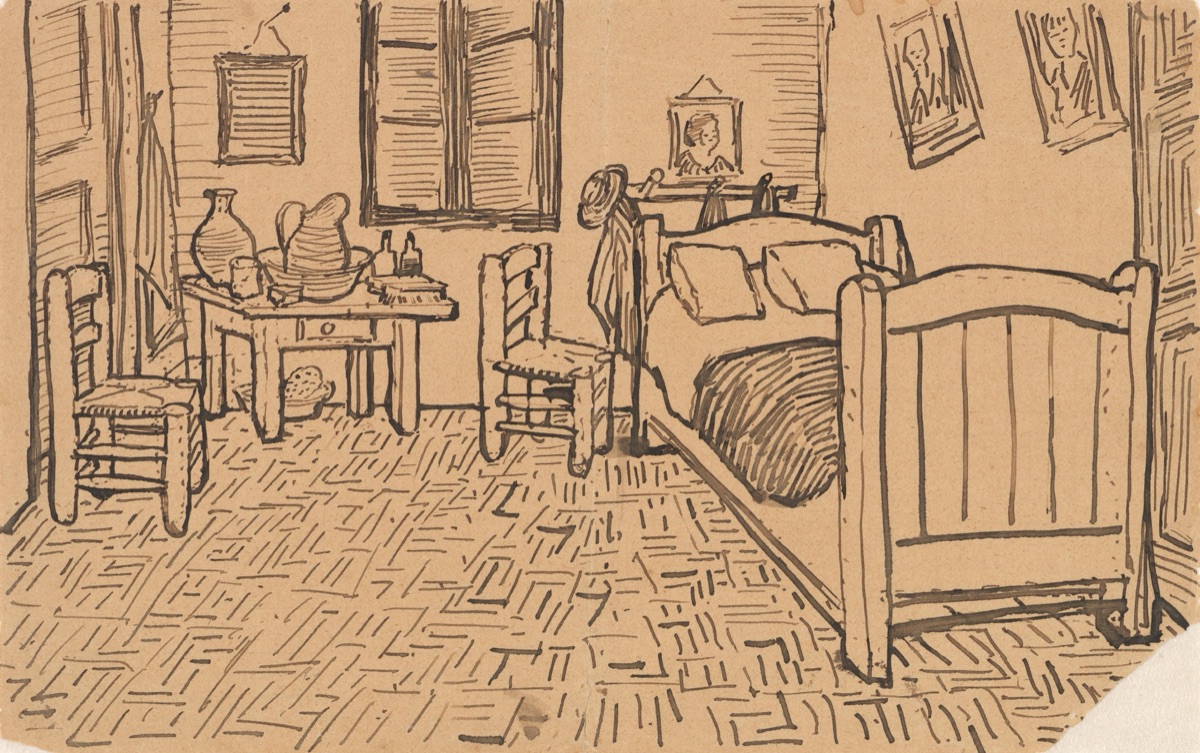
Arles, October 1888. A week before Gauguin arrives, Vincent paints his bedroom and writes the colors out for his brother Theo, starting with the walls. Look at them now.
- Tue 16
- Wed 17
- Thu 18
- Fri 19
- Sat 20
- Sun 21paint
- Mon 22paint
- Tue 23Gauguin
Build versus buy
Grind the violet.Buy the rest.
If it’s a core business function — do it yourself, no matter what.Joel Spolsky, In Defense of Not-Invented-Here Syndrome, 2001
Spolsky’s examples were plain: a drug company should write its own software for drug research, but not its own accounting package. He compared it to cooking: “When you’re a cordon bleu chef and you need fresh lavender, you grow it yourself instead of buying it in the farmers’ market, because sometimes they don’t have fresh lavender or they have old lavender which they pass off as fresh.” Martin Fowler drew the same line in 2010 between utility and strategic software: “it’s all about whether the underlying business function is a differentiator or not.” In this bedroom, the differentiator is the violet. Vincent wrote that the color had to do the job here, and the job was rest.
Before the tube
For most of the history of oil painting, someone had to grind pigment into oil before it could be used: the painter, an apprentice or a colorman. The paste was stored in bladders. Around 1400 Cennino Cennini wrote of vermilion that “if you were to grind it every day for twenty years it would still be better and more perfect.” In the same chapter he told painters not to make it themselves, but to “get some of that which you find at the druggists’ for your money, so as not to lose time in the many variations of procedure.” Buy it whole, he added: “Always buy vermilion unbroken, and not pounded or ground. The reason? Because it is generally adulterated, either with red lead or with pounded brick.”
On September 11, 1841, the portrait painter John Rand was granted a US patent for keeping paint in “grain-tin drawn into a tube.” By 1842 Winsor & Newton were selling “Rand’s Patent Collapsible Tube.” Jean Renoir later remembered his father saying: “Without paints in tubes, there would have been no Cézanne, no Monet, no Sisley or Pissarro, nothing of what the journalists were later to call Impressionism.”
Vincent’s paint
Van Gogh bought his. From Arles he sent lists to his brother Theo, who placed and paid for the orders, mostly with Tasset & Lhote in Paris and sometimes with Julien Tanguy, whose paint was cheaper and coarser. “His cobalt is too poor to order more from him,” Vincent wrote in June 1888. “His chromes are quite good.” He shopped like any buyer: one tube of Prussian blue, he noted, “goes as far as 6 ultramarine or cobalt and costs 3 times less.” On October 3, three weeks before Gauguin came, he wrote that the two of them would almost certainly grind their own. They kept buying. In November: “The consignment from Tasset arrived the day before yesterday, and we were very pleased with it.”
He knew some of it would not last. In April 1888, after checking that Tasset had sent the geranium lake, he wrote that the colors Impressionism had made fashionable were unstable, “all the more reason boldly to use them too raw, time will only soften them too much.” On October 22, the day before Gauguin arrived, he ordered ten more tubes of it.
What faded
His letter calls the walls pale violet, the floor red tiles and the doors lilac. In all three versions of The Bedroom the walls and doors are now light blue. Conservators who studied the first version, the one in this room, found geranium lake and cochineal in the floor and blamed the change on the “highly fugitive” geranium lake. The red that left the walls and doors has not been identified, only its absence. The proof is at the edges. Where a stroke on the door runs under the frame, it is still bright lilac, and a strip along the bottom that was taped over in 1931 is peachier than the floor above it. Around 1920 the painter Isaac Israëls painted the picture hanging in a studio with its floor still a brighter pink. The red outlines of the table and the left chair, done in a steadier kind of cochineal lake, kept their color.
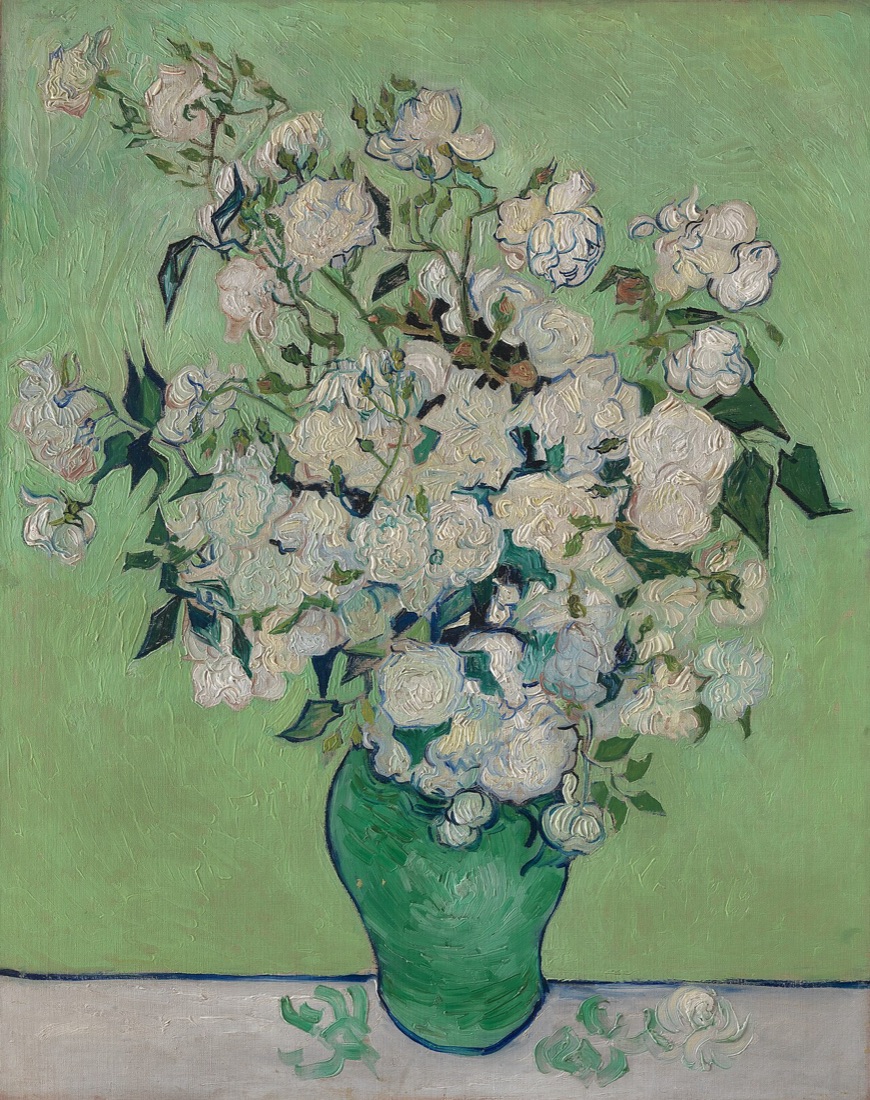
The Van Gogh Museum made a digital reconstruction of the purple walls and redder floor, and wrote that it “was hard for many to swallow.” The 1888 colors in this room are our own approximation in the same direction, not the museum’s. The Metropolitan Museum’s Roses from 1890 lost their red the same way.
Paint that changes on the wall
Software is mostly bought now: libraries, cloud services, models behind an API. Most of it holds, and buying it is what leaves the week free for painting. Dropbox went the other way for the one thing its business is: it moved its users’ files off Amazon S3 onto storage it built. Its 2018 IPO filing credits that work, along with closing long-idle free accounts, with cutting infrastructure costs by $39.5 million in 2016 and $35.1 million in 2017.
What you buy can change after you hang it. On March 22, 2016, an eleven-line npm package called left-pad was unpublished, and installs of Babel, Atom and React Native failed until npm restored it about two and a half hours later. In 2023, researchers at Stanford and Berkeley asked GPT-4 whether numbers were prime: it was right 84 percent of the time in March and 51 percent in June, under the same name. Critics argued that its habits had changed more than its ability, and agreed on the part that matters here: “Code that is deployed to users might simply break if the model underneath changes its behavior.” OpenAI shut down text-davinci-003 on January 4, 2024, six months after announcing it.
What to do
- Grind what the work is about. If it is the reason people come to you, make it yourself, the way Dropbox built storage. The test is the business, not pride.
- Buy the rest. Most of Vincent’s colors held. A day spent grinding blue for a basin is a day not spent painting.
- Buy it unbroken. Cennini’s advice still works: pin versions, keep a lockfile, and read what the changelog and the model card say is inside.
- Check it on the wall. Run your evals again on every model or library update, and keep the retirement dates on a calendar.
- Leave room for the drift you know about. Vincent painted his reds too raw on purpose, expecting time to soften them. It took more than softening.
About the picture
Van Gogh painted The Bedroom in Arles on October 16 and 17, 1888, and described it the same week in letters to Theo and to Gauguin. To Gauguin the walls were “pale lilac.” Gauguin arrived early on October 23. Vincent painted two more versions in 1889, now in Chicago and Paris; the first is in the Van Gogh Museum in Amsterdam. The week, the grinding and the price of a day in this room are ours. Vincent bought every color in it.