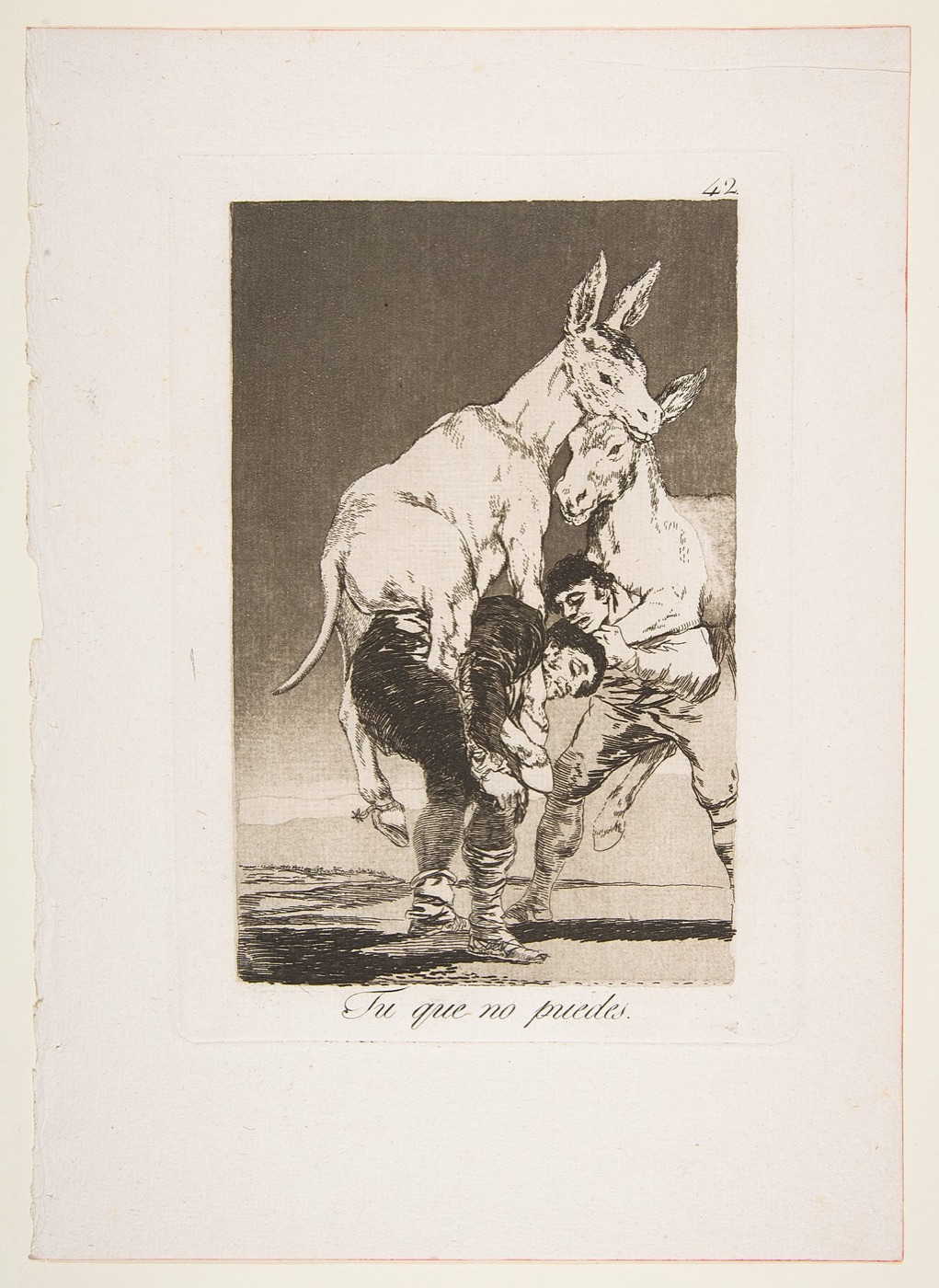
The Dilbert Principle After Francisco Goya
Up and out of the way.
“The most ineffective workers are systematically moved to the place where they can do the least damage: management.”
Scott Adams, 1995
The joke: promote a struggling worker so they stop causing problems. But now their decisions affect the whole team. In Goya’s picture, workers carry donkeys on their backs. Here, you carry the manager.
Choose a manager, then keep them balanced for 18 seconds, representing three months of work. Move toward the side they lean using your pointer, the left and right arrow keys, or the buttons. Try each person to see how much work the team gets done.
The Dilbert Principle
Management is not out of the way. It is on everyone’s back.
Goya’s caption is half a Spanish proverb: Tú que no puedes, llévame a cuestas. You who can’t, carry me on your back.
Scott Adams described the Dilbert Principle in The Wall Street Journal in May 1995 and in a 1996 book of the same name: the least effective workers get moved into management, where they can do the least damage. He meant it as a joke about offices, and as a twist on Laurence Peter’s 1969 principle that people rise to their level of incompetence.
The joke rests on an assumption the room tests: that a manager can’t do much harm. A developer’s bad day costs one change. A manager’s decisions land on everyone who reports to them, every week.
Research suggests companies usually promote strong performers, even when they may not be suited to managing people. Firms tend to promote their best performers, not their worst. In a study of sales workers at more than a hundred firms, Alan Benson, Danielle Li and Kelly Shue found that the best salespeople were more likely to be promoted, and that their teams then did worse. A new manager’s own sales record predicted lower sales for the people under them; experience helping colleagues predicted better results. Read the paper.
Managing people is a skill of its own, and it can be measured. At a large tech firm, Mitchell Hoffman and Steven Tadelis found that moving from a manager at the 10th percentile of people-management skill to one at the 90th predicted about 60% less turnover. Read the paper. Gallup has reported that managers account for at least 70% of the variance in team engagement.
The Dilbert Principle is satire, not a proven rule. The practical lesson is to choose managers for their ability to help a team. Give strong engineers ways to advance without becoming managers.
Mateo, Lucía and Ana are invented. Their decisions, the weights and the pace are illustrations, not measurements.