After Winsor McCay
Only Gertie Moves
- Year
- 1914
- Sheet
- 001 / 331
- Layers
- 1
- —
- —
1914. Winsor McCay is drawing a dinosaur for his vaudeville act: about 10,000 sheets of thin paper by his own count, and each one holds the whole picture. Riffle them and Gertie comes out.
“The separation of concerns… is yet the only available technique for effective ordering of one’s thoughts, that I know of.” Edsger Dijkstra, 1974
Separation of concerns
Draw the still things once.Split by how things change.
It is what I sometimes have called “the separation of concerns”, which, even if not perfectly possible, is yet the only available technique for effective ordering of one’s thoughts, that I know of.Edsger W. Dijkstra, “On the role of scientific thought,” 1974
Dijkstra dated the essay August 30, 1974, and the passage comes from a letter he had written to a friend. He meant a habit of mind before a habit of code: study whether a program is correct, then study its efficiency “on another day, so to speak,” knowing all along that the other aspects exist. “From this aspect’s point of view,” he wrote, “the other is irrelevant.” Software took the idea and gave it walls: modules, layers, files and services.
Everything on every sheet
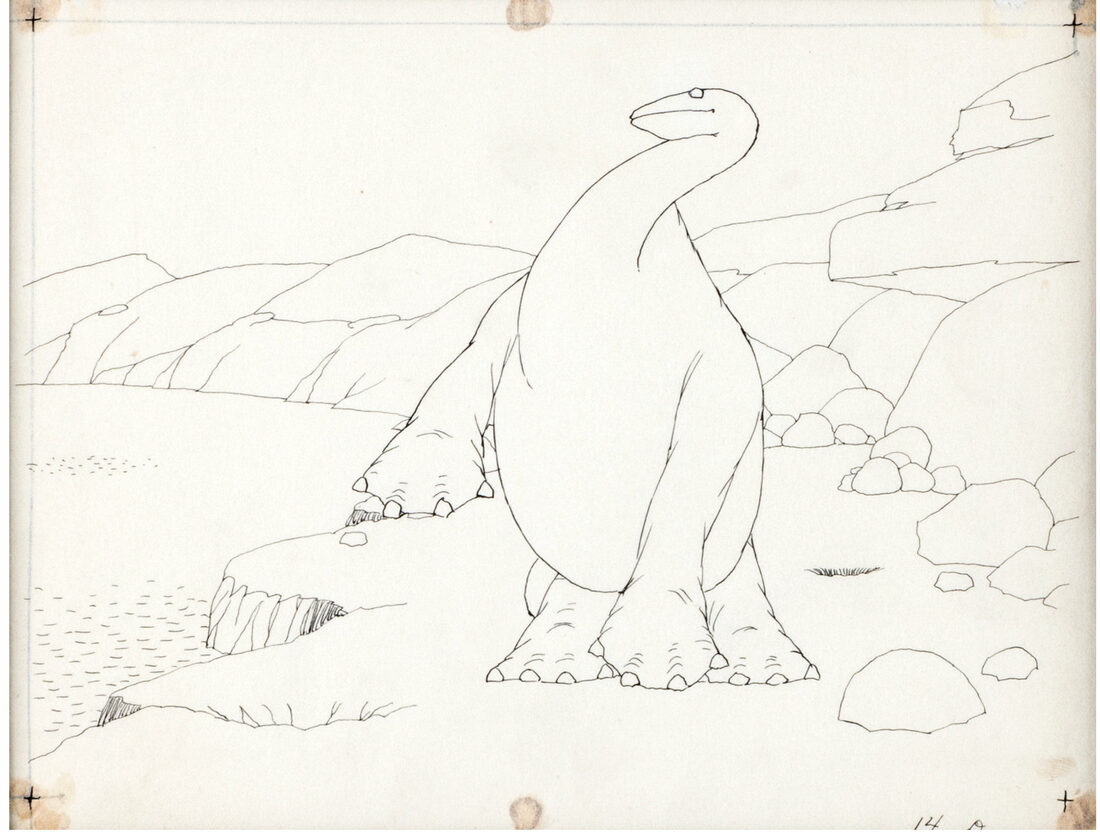
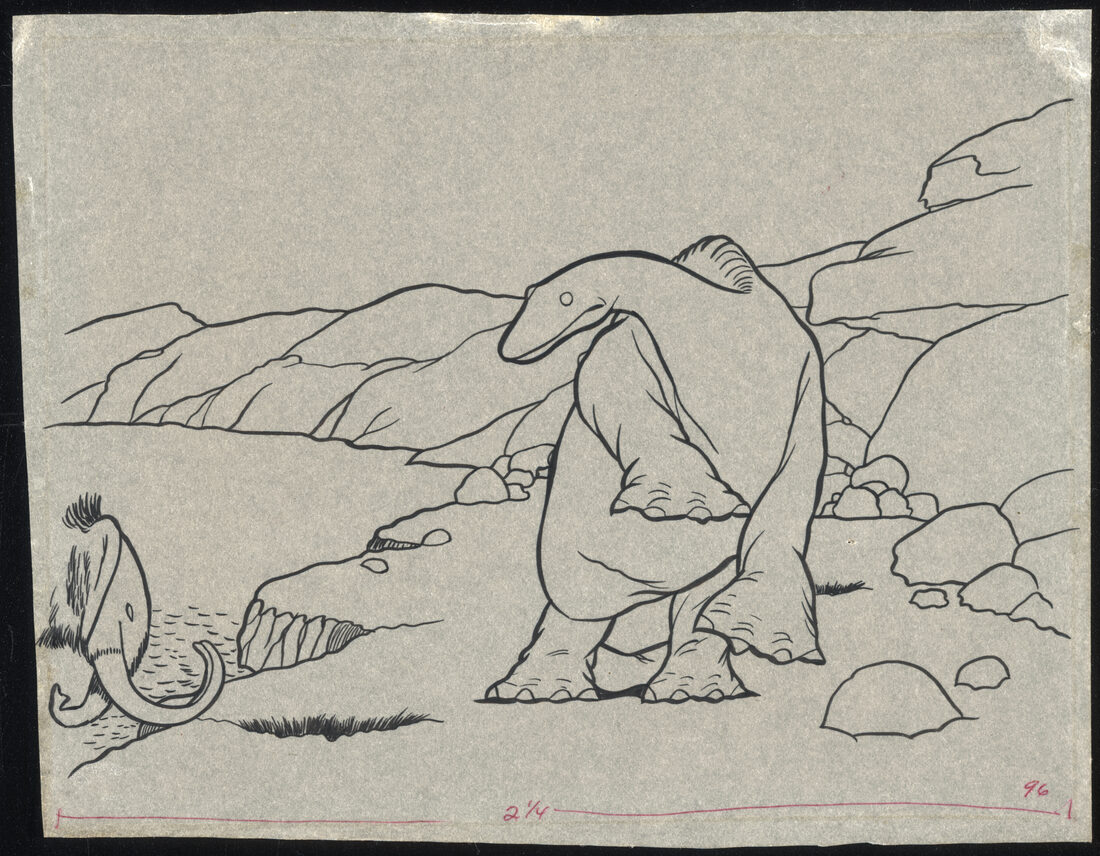
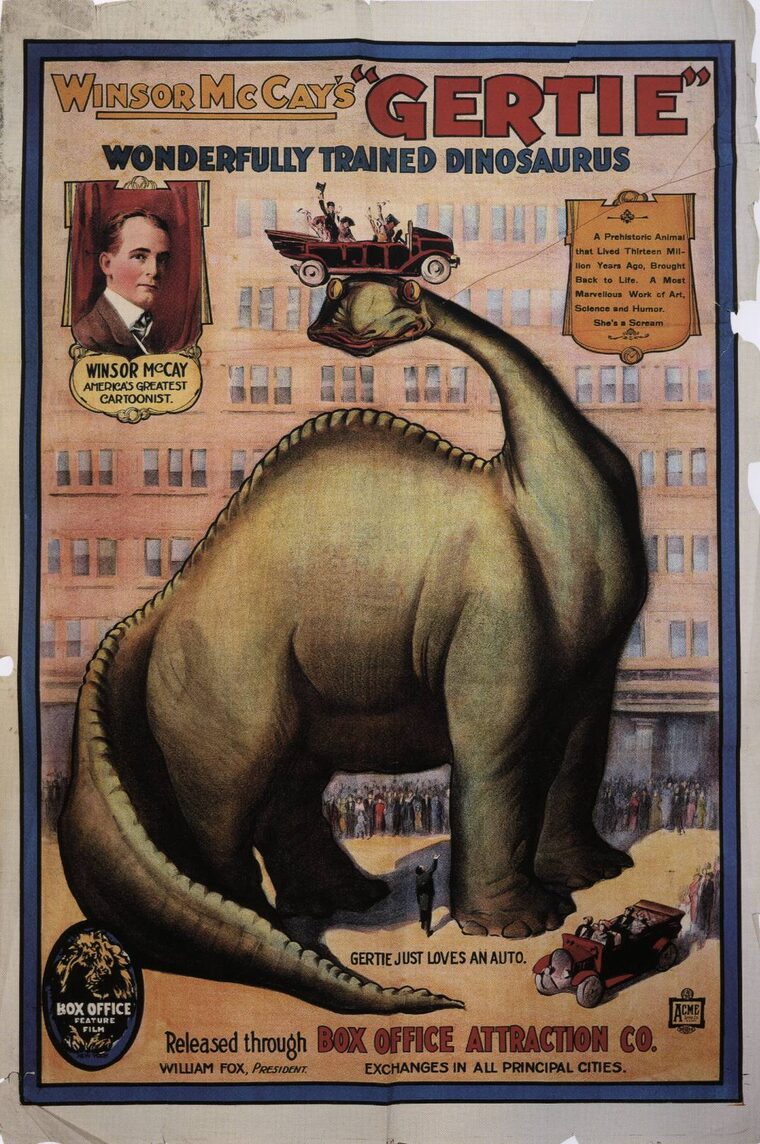
Gertie premiered on February 8, 1914, at the Palace Theater in Chicago, inside Winsor McCay’s vaudeville act. He stood beside the screen with a bullwhip, called out orders, and she obeyed. Every moment of her was a separate pen drawing on a sheet of thin paper, 6½ by 8½ inches, with registration crosses at the corners, and every sheet carried the whole picture. John A. Fitzsimmons, a 20-year-old art student who lived next door, traced the rocks, the lake and the tree onto each sheet from a master drawing. McCay said he made 10,000 drawings. The historians David Nathan and Donald Crafton doubt it: the animation in surviving copies runs about seven minutes and reuses cycles of drawings. About 400 sheets survive.
The retracing shows on screen. Crafton calls it “the infamous ‘weave’ of the background lines caused by retracing the same drawing a few thousand times.” McCay never patented his methods. “Any idiot that wants to make a couple of thousand drawings for a hundred feet of film is welcome to join the club,” he said.
Draw the still part once
Other people did patent them. John Randolph Bray, who had visited McCay saying he was writing an article, filed on January 9, 1914, for printing one background onto many translucent sheets, with blank areas left for the figures. Earl Hurd’s patent, filed December 19, 1914, went further: the still scene on one sheet, and only the moving parts on transparent sheets laid over it. Raoul Barré punched holes in his sheets and set them over pegs, so every layer lined up. Studios built whole departments around the split, and ink-and-paint artists traced each animator’s drawing onto clear celluloid. A year or two after Gertie’s premiere, an unknown studio copied her on cels over a still painting. Its background, the historian Jim Korkis wrote, “does not contain the unintentional movement of the original.”
The split is still how films are made. Pixar released its Universal Scene Description as open source on July 26, 2016. It stacks every shot in layers so that departments can “simultaneously work on the same asset or scene” without “erasing or editing any other artist’s work.”
Split by what changes
In 1972 David Parnas argued that a program should be divided by what is likely to change: begin with “a list of difficult design decisions or design decisions which are likely to change,” then design each module “to hide such a decision from the others.” The web learned the same lesson about looks. Early pages mixed what they said with how they looked, in tags like Netscape’s FONT and CENTER. Håkon Wium Lie proposed style sheets on October 10, 1994, and in May 2003 Dave Shea opened the CSS Zen Garden, one HTML page that designers could restyle only through their own style sheets. “The code remains the same,” it said, “the only thing that has changed is the external .css file.”
The scenery and the acting were the right cut for Gertie because they change for different reasons. Cut along anything else and you get two trees, or a layer that has to change every time its neighbor does. Pete Hunt made that case for React at JSConf EU in 2013: “Templates separate technologies, not concerns.” Markup and the logic that drives it change together, he argued, so they belong in one component. Adam Wathan made a version of it for CSS in 2017: “Instead, think about dependency direction.”
Cut too fine
Television cartoons of the late 1950s needed hours of film on small budgets. Hanna-Barbera’s characters wore collars and ties, the designer Iwao Takamoto explained, “so the head could be easily separated onto its own cel without a seam line.” Bodies held still while heads and mouths moved. Chuck Jones dismissed any cartoon you could follow by ear without looking as “illustrated radio.” A split saves work only when the two sides change apart. If they always move together, every change crosses the seam, and somebody has to draw the collar.
Orders on the same line
Concerns can also share a wire. The Bell System controlled its long-distance trunks with a 2600-hertz tone sent down the same line as the voices, so anyone who could whistle or play that tone could talk to the switch. The fix was a separate channel for signaling: the first common channel signaling link went live in May 1976, between Madison, Wisconsin, and Chicago. A 1978 article in the Bell System Technical Journal put the old problem plainly: signaling on customers’ voice circuits “makes the signaling vulnerable to interference and susceptible to fraud.”
Language models have the same trouble. A model reads its instructions and the text it works on as one stream; in Simon Willison’s words, “everything eventually gets glued together into a sequence of tokens.” A web page or an email can carry orders that the model then follows. Willison named the attack prompt injection on September 12, 2022, and OWASP ranks it first among the 2025 risks for LLM applications. The defenses that hold up separate control from data. In CaMeL, from researchers at Google, Google DeepMind and ETH Zurich in 2025, a privileged model writes the plan before any untrusted text is read, and a quarantined model that reads the text cannot change it. On the AgentDojo benchmark it finished 77% of tasks with provable security, against 84% for an agent with no defense.
What to do
- Draw the still things once. Layouts, settings and shared styles shouldn’t be redrawn every time the content moves.
- Split by reasons to change. Give each decision that might change a home of its own, as Parnas put it, hidden from the rest.
- Move things when they move. The tree was scenery until she ate it. When a concern crosses the line, move it instead of drawing two trees.
- Keep together what changes together. A head and a body that always move as one are one concern, however neat the seam looks.
- Give orders their own channel. Don’t let data, a web page, an email or a tool result, speak with the voice of an instruction, on a phone line or in a prompt.
- Remember “even if not perfectly possible.” The lamp lights every layer on the desk. Logging, security and speed cut across every layer of a program too; handle them on purpose.
About this room
The sheets you riffle are 331 consecutive frames from a restoration of Gertie the Dinosaur on Wikimedia Commons, traced into ink lines and played at that copy’s 15 drawings a second. Each keeps its own tracing of the scenery, missing rocks included, and the copy’s stretched width is corrected. This page pays McCay’s price too: every paper sheet arrives with its own copy of the scenery. In the split acts, each cel is cut from the same frame along whatever differs from the empty scene at the start of the film, and that empty frame is the scenery card. The card without the tree borrows its strip from frames after she eats it. The park is from McCay’s unfinished Gertie on Tour, circa 1918 to 1921. His Gertie always stood in one spot in that scene, so we filled the gap and set the dance in front of it. The sheet numbers, the red marks, the collar and the bow tie are ours.
Sources
Dijkstra, EWD447Crafton, 2018Korkis, part oneKorkis, part twoAFI CatalogBray’s patentHurd’s patentInk and paintOpenUSDParnas, 1972Lie, 1994CSS Zen Garden, 2003Hunt, 2013Wathan, 2017Takamoto on collarsKenner on Chuck JonesBell System, 1978Willison, 2022Willison, 2025CaMeL, 2025OWASP LLM01The filmGertie on Tour